How to correctly measure a staircase
Measuring a staircase is an important step in its planning and production.
TOOLS FOR ACCURATE STAIRCASE MEASUREMENT
- a straight long batten or plank, or an aluminium screed
- a spirit level approx. 1 m long
- a tape measure – ideally a 5 m retractable one
- a large square or another tool for checking a right angle (a plasterboard panel, polystyrene board, etc.)
- a regular pencil
01
Determining
THE POSITION OF THE STAIRCASE START
Determine the position of the staircase start, i.e., the front edge of the first step = establish the staircase length.
This is usually specified in the project documentation. If it is not defined, the staircase length can be derived using the following guideline:
An optimal staircase requires approx. 165 mm of floor space for every 100 mm of height; for a height of 2800 mm, this equals 4600 mm.
A steep staircase: approx. 140 mm of floor space for every 100 mm of height; for a height of 2800 mm, this equals 3900 mm.
A very comfortable staircase: approx. 190 mm of floor space for every 100 mm of height; for a height of 2800 mm, this equals 5300 mm.
02
Checking the
ANGLE OF THE TOP EDGE
Check the right engle of the top edge of the staircase in relation to the length measured in the next step. If the angle is “closing in”, this must be taken into account and the deviation subtracted from the measured horizontal length.
03
Measuring the
LENGTH OF THE FLIGHT
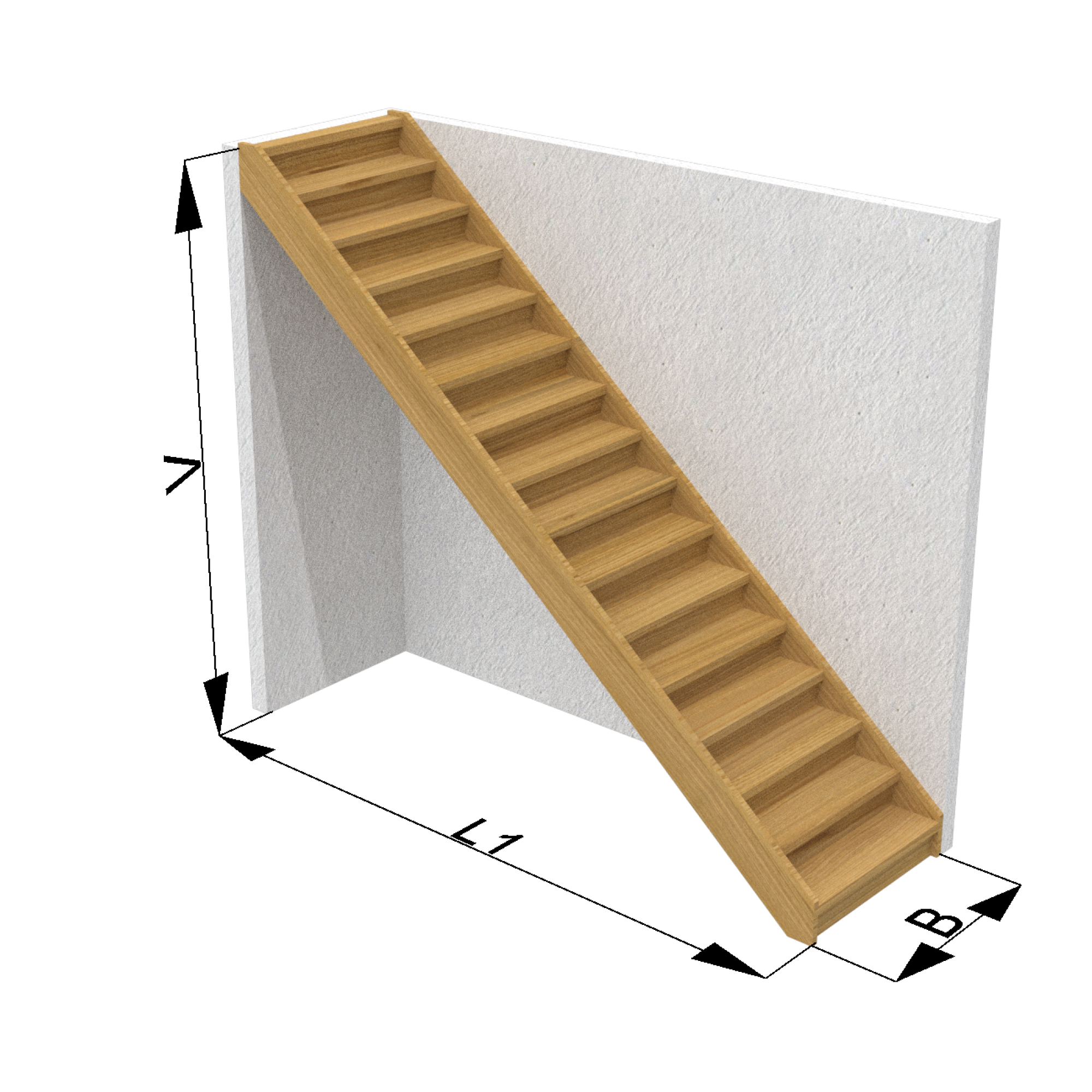
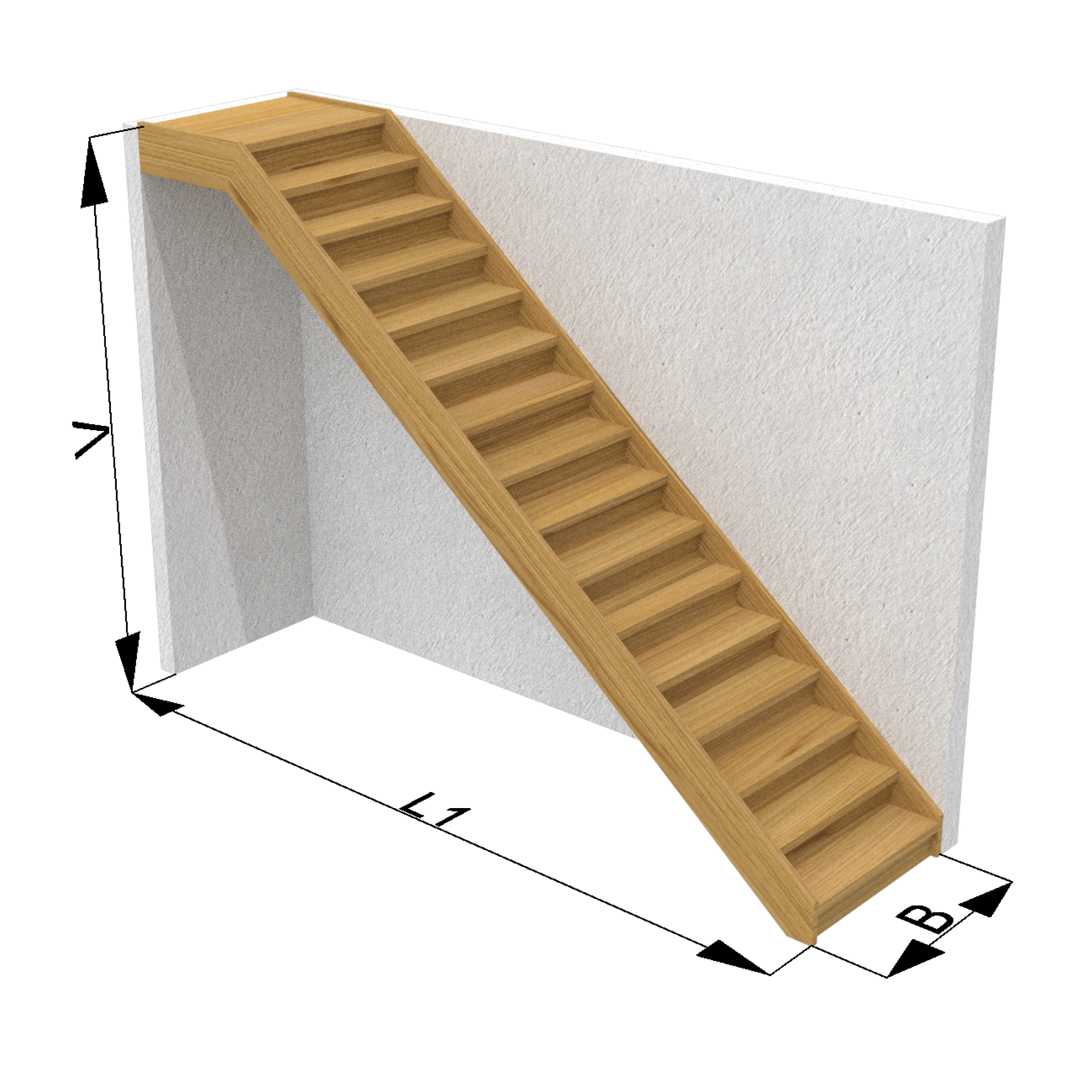
Now measure the length of the flight L1 – drop a plumb line from the top landing to the lower floor (ideally along a wall running beside the flight, if one exists), and from that point measure the distance to the starting edge from point 1.
If there is a wall directly under the top edge down to the floor, the measurement is easier. However, do not forget to check vertical alignment and correct it if necessary. If the top edge is “recessed” behind the plane of this wall, be sure to add the difference.
Be aware of any existing (or future) door trim near the staircase entry – this may collide with the stringer. It is also advisable to measure openings, doors, and other elements on the wall next to the staircase and again assess the possibility of interference.
04
Measuring
OPENING AND STAIRCASE WIDTH
Measure the width of the structural opening and determine the staircase width accordingly; we recommend a minimum width of 1 m, while the limiting factor is the size of the finished structural opening itself. It is also necessary to take into account the thickness of any ceiling cladding and leave approximately 40 mm of space along the future handrail for finger clearance.
To compensate for possible wall unevenness, we recommend reducing the staircase width by 5 mm.
05
Measuring
STAIRCASE HEIGHT
When measuring the height, it is recommended to follow these guidelines: take the measurement at the center of the future top edge of staircase width to eliminate floor unevenness. Using a long straight batten and a spirit level, check the levelness of the lower floor between the staircase start and the point directly below the staircase exit where the vertical height is measured. Correct the measured staircase height according to any detected difference.
Ideally, the height difference should be measured between the finished floor surfaces. If the final floors are not yet completed but their build-up layers are already defined, it is easiest to simulate the future thicknesses (parquet, tiles, marmoleum, etc.) and again measure the difference between the finished floor levels. This helps avoid mistakes when subtracting or adding floor thicknesses.
06
Measuring
HEADROOM CLEARANCE
The final important staircase dimension is the headroom clearance. This only applies to staircases where the staircase start is located beneath a ceiling. It is measured as the clear vertical distance between the lower edge of the ceiling opening and the stair tread directly below it. The ideal clearance is 220 cm or more.
If it can be determined and calculated from the project documentation, it should definitely be checked.
07
Case
of Two Staircases Above Each Other
When designing two staircases positioned above one another, it is necessary to consider the size of the opening beneath the upper staircase during the planning stage. This prevents a situation where the staircase would partially “fall into the opening.” We therefore recommend that the upper staircase overlaps the opening below by 100–150 mm.